
Period: 01.01.2026 – 07.01.2026
Key Events:
Paris negotiations (Jan 6–7) – leaders of Ukraine, US, UK, France, allies.
German information field reaction to Paris negotiations of allies on Ukraine:
To further test the initial hypothesis on event-dependent dynamics of German public attention to the Ukraine war, analysis continued for the period 01.01.2026 – 07.01.2026, with the key event being the Paris negotiations of the leaders of Ukraine, the USA, the UK, France, and other allies on 6–7 January 2026.
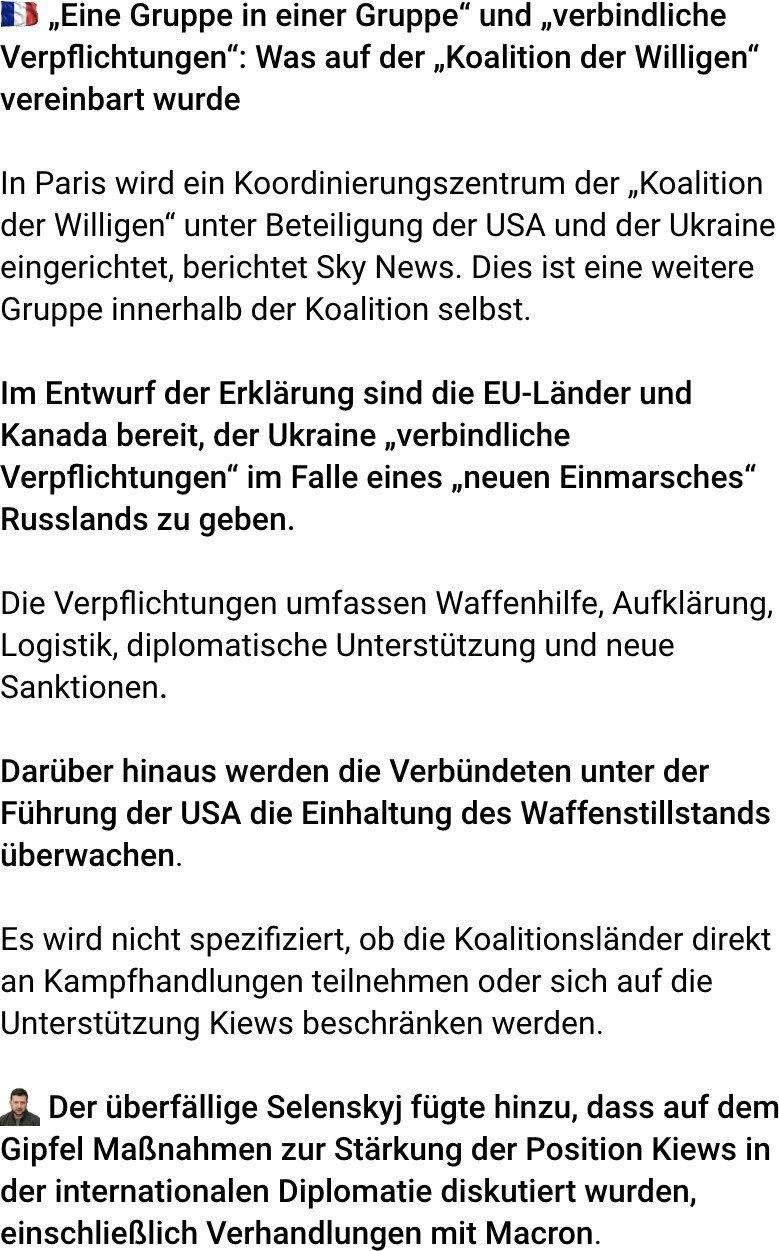
According to international agencies (Reuters), the negotiations resulted in fundamental agreements regarding:
- defense guarantees for Ukraine in the event of war cessation;
- development of a potential peacekeeping or stabilization mission format;
- readiness of certain European countries (notably the UK and France) to provide military support, including potential future troop deployments.
These signals were highly resonant internationally and served as a catalyst for both official media discourse and alternative platforms, including German-language
pro-Russian outlets.
2. Information reaction and narratives
Against the backdrop of the Paris negotiations, the Russian Federation publicly responded with harsh rhetoric, stating that any foreign troops on Ukrainian territory after a ceasefire would be considered “legitimate targets.” This statement became a key trigger for spreading escalation narratives and discrediting Western initiatives.
On pro-Russian German-language resources (notably anti-spiegel.ru), the events were interpreted within several established propaganda frameworks:
• Narrative of Western incapacity
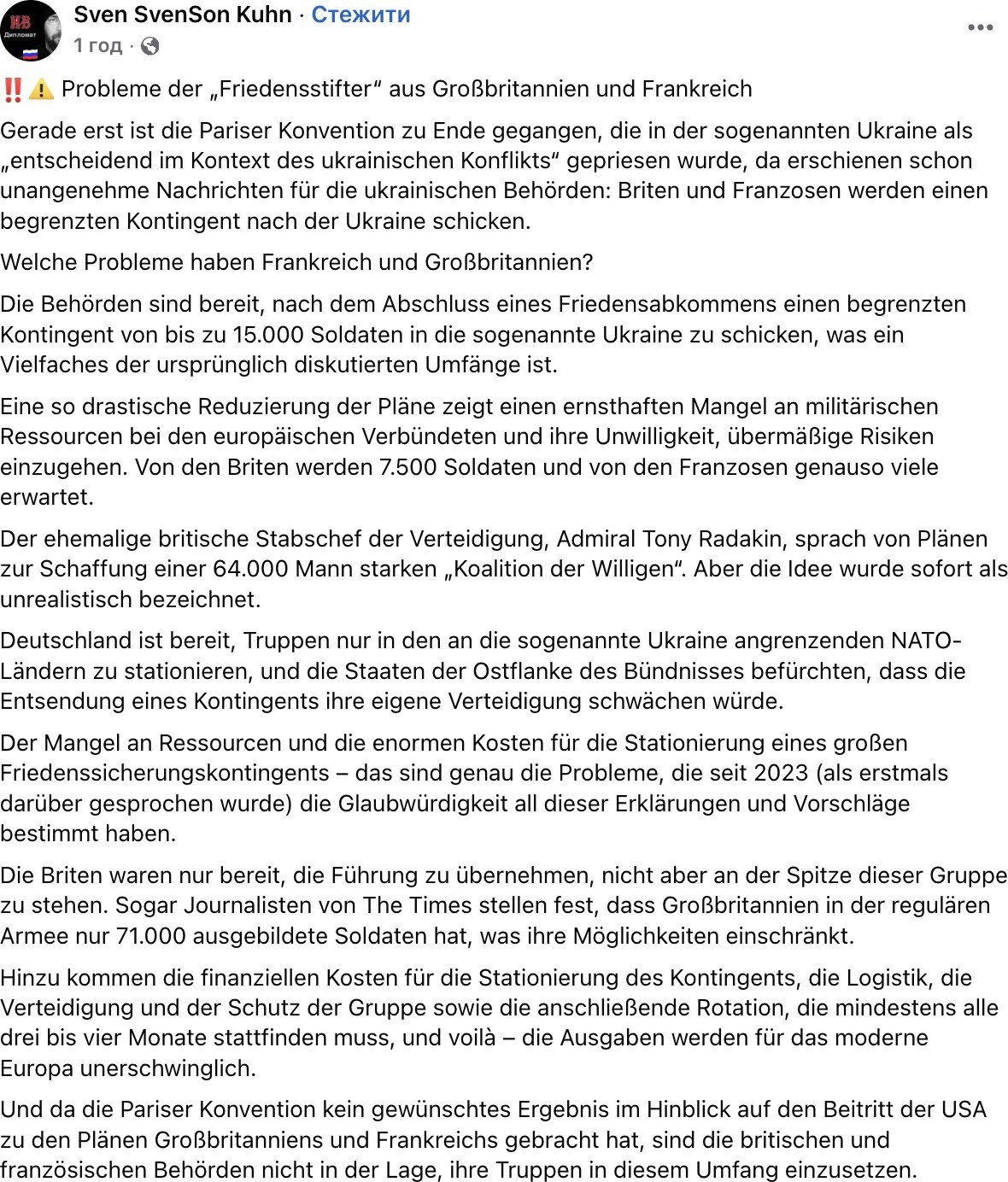
The Paris negotiations are portrayed as evidence of a lack of military resources among European allies. Emphasis is placed on:
- the “limitations” of potential contingents;
- comparisons with previously announced, much larger figures;
- claims that European countries are unwilling to assume “excessive ”
• Discrediting the idea of a peacekeeping mission
Peacekeeping or stabilization plans are depicted as:
- unrealistic;
- financially unfeasible for modern Europe;
- doomed due to logistical challenges and the need for constant rotation of
• Involving Germany in the context of escalation fears
It is separately emphasized that Germany allegedly:
- is not ready to send troops to Ukraine;
- is limited to deploying forces only in neighboring NATO countries;
- fears weakening its own defense
Thus, a perception of “internal Western contradictions” and lack of unity is formed.
The list of the media channels with Russian propaganda you can find here – Pro-Russian Social Media Profiles
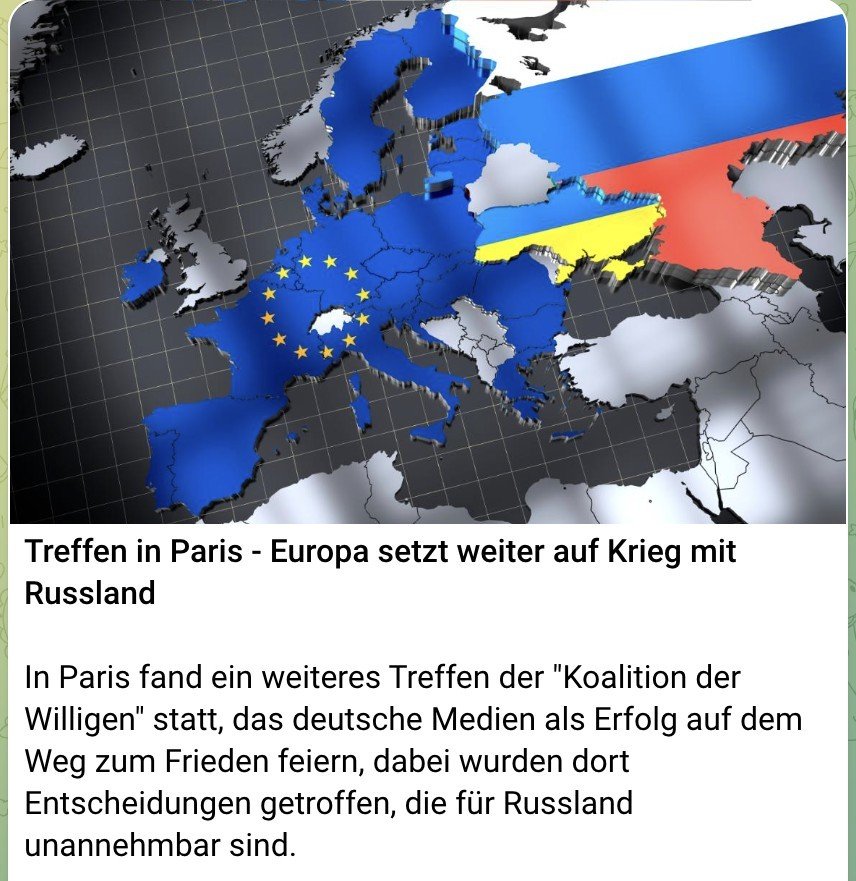
07.01.2026 – Telegram Post
07.01.2026 – Telegram Post
08.01.2026 – Facebook Post
Executive Summary:
The analysis shows that the Paris negotiations became a significant informational trigger that:
- caused a new surge of interest in the Ukraine war;
- activated pro-Russian interpretations of events in the German-language segment;
- was used to strengthen narratives of Western weakness, escalation risks, and financial incapacity of European allies.
At the same time, the reaction indicates that these information waves are not spontaneous but quickly structured around pre-prepared propaganda frameworks.
Pro-Russian resources systematically use such events to shift attention from the essence of the agreements to their alleged unrealistic nature, high cost, and internal contradictions among allies.
Thus, data for 01–07 January 2026 further confirm the initial research hypothesis: German public attention to Russia’s war against Ukraine is event-sensitive, and key diplomatic and security signals quickly transform into information waves used both to support and discredit Ukraine within alternative and propaganda media.
Practical conclusion: each such event should be considered not only as an information risk but also as a point of intervention. Effective response entails:
- timely delivery of explanatory messages in the German information field;
- focus on security and legal aspects of decisions sensitive to the German audience;
- reducing the informational vacuum, which would otherwise be quickly filled with alternative interpretations.
The question is therefore the ability to systematically work with attention peaks, transforming them from a tool of discreditation into an opportunity to form a more resilient and informed public perception of the war and Germany’s role in European security.